
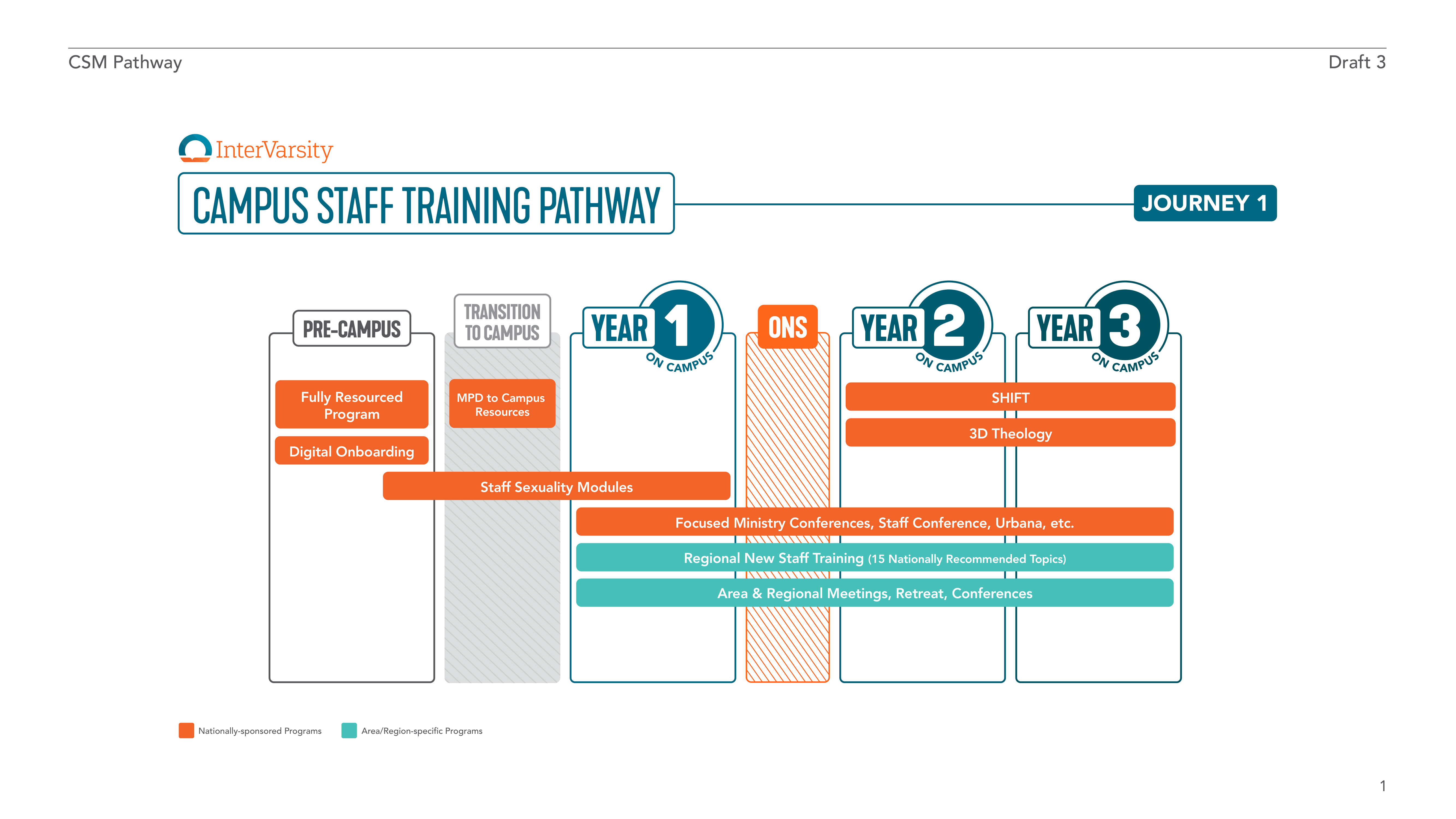
Campus Staff Pathway Details
Our expectation is that all staff working 20+ hours weekly will complete the Campus Staff pathway within 4 years of their appointment, depending on when they attend ONS. This model provides national coherence while preserving regional flexibility. The Campus Staff Pathway provides a predictable and sustainable sequence to complete all required training.
For 2026-2027, Regional Directors need to map out when their Campus Staff will complete the nationally sponsored programs.The training team will provide annual updates to VPs/RDs to enable appropriate accountability to these expectations.
The Fully Resourced Program (FRP) is a national, time-tested program which supports new staff to raise their full ministry budget. Through a combination of focused training, skilled coaching, clear goals and cohort communities, 80% of new staff raise their full budget within 6 months.
- MPD 101/201
- MPD 102/202 (Launch Week)
- MPD 103
- MPD 104
A Workday app that allows new staff and their supervisors to track onboarding progress of tasks and training within their first months on staff. The onboarding learning content is automatically released to coincide with three milestones in a new staff’s journey – provisional appointment, start of pay, and start on campus.
7 days in person. $1850.
A foundational program for new staff that introduces InterVarsity’s national ministry, clarifies the role and expectations of InterVarsity staff, and outlines the key ways the organization supports campus work, all in the context of a shared learning community.
Online: $0 through June 2030
In person:
– Through November 2028: $0
– November 2028-June 2030: $0 program cost, but staff pay their own travel.
An intensive introduction to InterVarsity’s theological approach, representing both our values and our method for how we “do theology” together as an interdenominational, Bible-based, missional movement. Both online and in-person options are available.
3 days online. $75
SHIFT is InterVarsity’s diversity training that helps employees grow as diversity leaders, providing practical skills and a shared framework for both professional and personal development.
6 asynchronous modules. Available in onboarding, not required to be completed until before ONS.
This course explores InterVarsity’s pastoral approach to and theological convictions about sexuality.
A shared foundation for preparing CSMs for campus work in their first three years.
Many regions will have all or most of these covered via their regional new staff training programs. Sample training designs for these topics are intended to be a starting point, led by an instructor (AD or regional trainer), and taking approximately 90-minutes.
MPD to Campus Resources provide supervisors with a “menu” of tools and supports to help staff successfully transition from full-time MPD into campus ministry by finishing MPD well and shifting physically, mentally, and spiritually into to their role on campus. Supervisors can discern which resources are most helpful for each staff person, including for some in Journey 2 who may benefit from an additional transition period after completing their second round of the Fully Resourced Program (FRP).
Campus Staff Pathway Options
These are based on FRP/ONS timing.
Journey 1
ONS after 1-year on campus

Journey 2
ONS after 2nd year on campus

Questions and Answers
-
This seems like a lot of new training. Is this too much to ask for new staff? (time off campus, financial cost, complexity)?
It may feel like a lot, but most of this is actually not new. These trainings are already required: we’re simply putting them in a clear, logical sequence. Clarity is kindness, and we want to eliminate surprises for you, your ADs, and your staff.
We acknowledge: the one piece that may feel newer is 3D Theology. Even with that included, the total time we ask a staff to spend on training over 4 years is 41.5 days. That includes MPD training, onboarding, ONS, sexuality, SHIFT, 3DT, and 15 nationally recommended training topics for campus. (For context, in terms of time, this is roughly 66% of what Cru requires their staff in the same time frame, and less than 30% of the financial cost.)
Click here for more details on each program represented in the Campus Staff Training Pathway. The costs for each part of the Pathway will be clearly communicated in each year's budget kit.
Regions still have significant agency in how this is implemented. We’re clarifying the 15 nationally recommended topics, but many regions will continue offering these trainings in-house, in ways that fit their context.
We are also working on consolidating the offerings for these national trainings into predictable "Learning Weeks" throughout the year so you’ll know in advance what the options are for when staff can take the trainings well ahead of time. These offerings will include options in a variety of lengths and formats. Check the Field Staff Training Events site for the latest updates.
-
So how does this all work? Are my staff going to start getting e-mails telling them they must finish a training by a certain date? Am I going to have to keep track of it all?
In many ways, things will feel very familiar. You’re not suddenly responsible for new deadlines, and you’re not on your own in tracking everything. The Training Team is a partner with you in developing your staff, and our systems will support what you’re already doing.
Digital onboarding resources will continue to roll out automatically via the onboarding dashboard on Workday to new staff during their first few months. Your relationship with MPD and Fully Resourced will also stay largely the same.
You can keep sending your staff to ONS the way you always have. A few small changes once they sign up for ONS:
- As part of their ONS pre-work, we’ll help keep them accountable for completing the sexuality training, which is first introduced during onboarding. We piloted this in 2025 with good results. 100% of staff completed the training before ONS and the whole learning community experienced strong benefits.
- One idea to consider: setting a regional window for new staff to complete the course so they move through it alongside peers. This helps new staff feel less alone as they engage the material. At the same time, if complex or sensitive questions arise, staff should be directed to the nationally hosted office hours (details found at the end of each course), where trained facilitators are available to address them.
- At ONS, we’ll cast vision for SHIFT and 3DT as part of their natural next steps. Afterward, they’ll get gentle, periodic reminders about the two-year window for completing those trainings, so you don’t have to carry all of that follow-up on your own.
Behind the scenes, the Training Team (in partnership with Diversity and Theological Formation) will maintain completion records and share them regularly with regional leaders, giving you clear visibility without added administrative load.
And throughout the year, we’ll publish Learning Weeks offerings well in advance, ideally up to a full year out, so that supervisors and staff can plan for SHIFT and 3DT at a time that fits your region’s rhythms. Check the Field Staff Training Events site for the latest updates.
-
My region has a strong new staff training program for the first 1-2 years. What does this mean for our program?
In most cases, very little. You’re likely already covering the 15 nationally recommended topics in your program, so keep going.
You’ll have access to national resources as you update or refine your program. Ideally, your regional trainers are already connected with the Training Team through periodic gatherings of new staff trainers (please reach out if you haven’t been able to make it!). We’re here to support, resource, and consult with you as needed.
Click here for sample 90-minute training sessions on each of the 15 topics. (currently under construction as of March 2026)
As for SHIFT and 3DT, in many cases these aren’t even put on your staff’s radar until they’re finished with your regional new staff training program. If it does overlap, you’ll have a large window to work out with staff when they can do SHIFT or 3DT.
Please feel free to rech out to the Training Team ([email protected]) for a consultation on how your regional training program connects with the 15 nationally recommended topics.
-
My region does not have a new staff training program. What does this mean for us?
You may not have a structured program, but you’re almost certainly training new staff in meaningful ways already, and that counts. As long as staff reach proficiency in the key skills by the end of year three, there’s no requirement to follow a specific format.
You will have access to off-the-shelf resources that an AD or TL can use to cover the recommended components of the Campus Staff Pathway. Click here for sample 90-minute training sessions on each of the 15 topics. (currently under construction as of March 2026)
In addition, courses on some of these topics will be available virtually and in person during Learning Weeks, which your staff can join at your discretion.
And you won’t be doing this alone: the Training Team is available to consult and help you shape an approach that fits your region’s needs. Please reach out for a consultation! ([email protected])
-
What happens if someone doesn't follow this? Are there consequences?
There are no external or punitive consequences. Our goal isn't enforcement; it's partnership and clarity in developing staff. We encourage this timeline because it helps staff receive the InterVarsity DNA that's foundational to their growth and to our shared mission.
The “consequences” we imagine are developmental rather than disciplinary: slower growth, feeling disconnected, or having less ownership of the larger vision. Because the CSM Pathway equips staff in core aspects of being on staff, we recommend your staff complete the required elements before promoting them. Still, those decisions ultimately remain with supervisors who know their people best.
Click here for more details on the expectations for the CSM Pathway.
For extreme part-timers, you may decide that a different pace makes sense. But for staff who are central to your team’s work, we encourage using the pathway as designed (which should for about 80% of your staff) and being intentional and thoughtful with any outliers. You’re not alone in that discernment; we’re here to support you as you navigate unique situations.
Click here for some sample User Journeys that highlight how the same framework can flex for real people in diverse roles and stages, including a sample of someone promoted to the AD role before completing all the elements in the Campus Staff Pathway.
-
What about part-timers?
We want you to feel empowered to make the decision that best fits their role and capacity. For staff < 20 hours/week, you can decide whether or not they should attend ONS. If they do, SHIFT and 3DT will follow, and you have agency to grant them extensions. You also have the flexibility to send them to SHIFT and/or 3DT even if they do not attend ONS. The goal is to use the pathway in the way that is most helpful for their situation.
-
What about external hires?
The pathway still applies, but you may want to adjust timing based on their background. Some may benefit from doing SHIFT earlier to absorb InterVarsity DNA on diversity on the front-end of their journey. For external AD hires, pacing will take more intentionality. We strongly recommend starting with NADT. From there, we recommend prioritizing sexuality first, followed by SHIFT, then 3DT. If they don’t make it to ONS in their first few years, they can always join ONS later as an SG leader.
Click here for some sample User Journeys that highlight how the same framework can flex for real people in diverse roles and stages.
-
What about staff who are not new but haven't completed required trainings? (ie: a staff who went to ONS more than 2 years ago, but has not completed SHIFT)
Our commitment is to communicate clearly about upcoming options and to work in good faith with supervisors to help their staff participate at the right time and according to their needs. There are no external consequences for staff who didn’t go through the new pathway, and there will not be hard, mandated deadlines. If you have questions about what’s best for your staff, please reach out ([email protected]).
-
What about student interns?
This doesn't affect student interns. If anything, it may help them move more quickly through parts of the pathway, especially if some of the 15 topics were already covered in their intern training.
-
What about Team Leaders?
This doesn't impact TLs. We are aware of a need for more consistent development and training for TLs. This could be a potential future project the Training Team works on.
-
Can you give me an example of a journey?
Absolutely. Check out the Pathway User Journeys for sample personas and their journey.
These user journeys show how the same framework can flex for real people in diverse roles and stages. Our goal: a shared, reliable pathway that provides clarity while still leaving room for nuance and wisdom in application. -
Tell me more about these 15 nationally recommended training topics.
These topics emerged from extensive input: over 60 staff from a wide range of roles contributed their insights (including many of you!). Across all that feedback, these 15 consistently rose to the top as the most essential for helping new staff be equipped for campus work.
Nationally provided resources are available for your use or adaptation, but you are always free to deliver these topics in the way that best fits your region. The goal is shared clarity, not one-size-fits-all implementation.
The Training Team is committed to refreshing these resources on a regular basis.
Click here for a summary and background/context on the 15 topics.
-
About these "Learning Weeks": are you saying my staff are always going to be off campus during those weeks?
Not at all. Learning Weeks are simply the windows when we’ll consolidate most national trainings: SHIFT, 3DT, and other campus-oriented and staff development-related offerings. This helps create predictability, so you know when options are available, but it is not mandating that staff must be off campus during these times. In addition, we’ll be offering courses of multiple lengths and formats. While some other courses will be multiple sessions (e.g. SHIFT, 3DT), other courses could be as short as 90 minutes. Most courses will be online, but some can be in person for a richer learning experience.
Participation will always be a joint decision between the staff and their supervisor. You’ll have full flexibility to choose whether a Learning Week makes sense for your context and your team’s rhythms.
While these are not final, the current proposed Learning Weeks are:
- First week of February
- Last week of June (overlapping with NADT)
- (An additional, floating week in July)
- Second week of November (overlapping with Cultivate)
We’ll keep you informed well ahead of time so you can plan in partnership with your staff rather than being surprised.
Offerings for June 2026 and all of 2026-2027 will be shared by May 2026. check the Field Staff Training Events site for the latest updates.
General Questions
Personnel Questions
Content Questions